


The History of Rancho Santa Fe: From Spanish Land Grant to One of California’s Most Coveted Communities
There are few communities in the United States where the past is so visibly woven into the present. Walk through the Village of Rancho Santa Fe today — past the arched doorways, the terracotta rooflines, the eucalyptus-lined roads curving gently with the contours of the land — and you are walking through a story that spans nearly two centuries. It is a story of ancient peoples, Spanish colonization, a railroad gamble that failed spectacularly, and ultimately one of the most deliberate acts of community-building in California history.
Understanding that story is part of what makes Rancho Santa Fe unlike anywhere else.
The Kumeyaay and the Origins of the Land
Long before Rancho Santa Fe became a destination for the discerning, the rolling hills of what is now North County San Diego were home to the Kumeyaay people, who inhabited the region for thousands of years. The land they called home — its oak-studded valleys, coastal sage, and river corridors — was rich, temperate, and deeply familiar to those who lived within it.
During the Spanish colonial period, the area was given pueblo status in recognition of its native population. It was a designation that acknowledged the land’s deep human roots even as the forces of colonization began to reshape everything around it.
The Osuna Legacy: Rancho San Dieguito
In 1831, Librado Silvas obtained a provisional grant to a portion of the land under Mexican Governor Manuel Victoria. After Victoria’s overthrow, Juan María Osuna — a soldier, rancher, and the first elected alcalde (mayor) of the Pueblo of San Diego — received permission to occupy the full property. He took possession in 1836, and in the early 1840s received a provisional land grant. In 1845, Governor Pío Pico formally awarded him full title to the 8,824-acre Rancho San Dieguito.
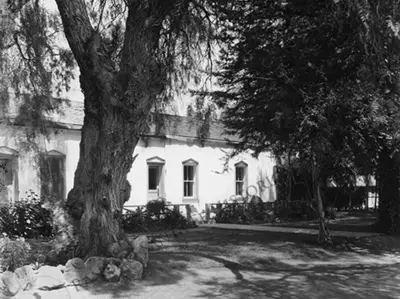
Osuna built an adobe ranch house on the property — the structure now known as Osuna #2 — while his son Leandro managed operations from an earlier adobe, Osuna #1. The original Osuna Adobe, dating to the 1830s, still stands today as one of the oldest surviving structures in the region. It is now cared for by the Rancho Santa Fe Historical Society and stands as the final remnant of the Osuna legacy in public, nonprofit ownership — a quiet but profound link to the land’s earliest history.
The Osuna family held the ranch through California statehood in 1850 and beyond, though the land gradually passed out of their hands through debt, tragedy, and time. By the turn of the 20th century, the last parcel of Osuna land was sold, and a new chapter was about to begin.
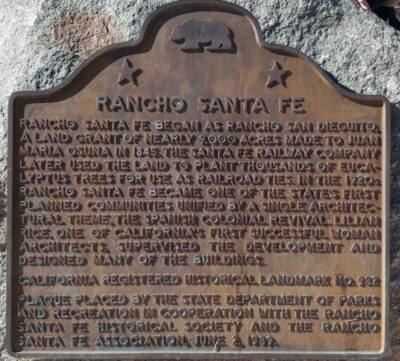
The Railroad’s Gamble: 3.5 Million Eucalyptus Trees
In 1906, the Atchison, Topeka & Santa Fe Railroad purchased the entirety of the original land grant with a single pragmatic goal: grow eucalyptus trees to supply timber for railroad ties. Between 1906 and 1914, under the direction of Santa Fe’s California vice president Walter E. Hodges, an estimated 3.5 million eucalyptus trees were planted across 3,000 acres of the property.
It was an enormous undertaking — and a spectacular failure. When the railroad spikes were driven in, the eucalyptus wood split. The trees had to reach old growth to carry the structural load required, and the timeline wasn’t viable. By 1916, the operation was abandoned.
It was one of the luckiest mistakes in Southern California history. The groves remain to this day, lining the lanes of the Covenant and giving Rancho Santa Fe one of its most distinctive and beloved characteristics.
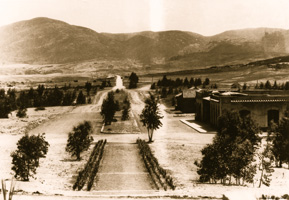
A New Vision: The Gentleman Farmer’s Community
Rather than walk away from the land, the Santa Fe Railroad formed the Santa Fe Land Improvement Company (SFLIC) and pivoted toward something far more ambitious. Persuaded in part by San Diego developer Colonel Ed Fletcher, who recognized the land’s agricultural potential, they envisioned a rural residential community for “gentleman farmers” — a master-planned enclave of country estates devoted to citrus, avocado, and the California outdoor life.
The railroad built the Lake Hodges Dam in 1920 to secure a water supply, renamed the development Rancho Santa Fe in 1921, and appointed land engineer Leon Sinnard to lay out the community. Sinnard took advantage of the rolling topography, planning a network of winding roads that followed the land’s natural contours rather than imposing a grid — a design decision that still defines the experience of driving through the Ranch today.
At the center of the plan was a Village: a civic core of small lots surrounded by large residential estates, most with citrus groves or orchards. To give it architectural form, the SFLIC turned to the San Diego firm of Requa and Jackson.
And that is where Lilian Rice enters the story.
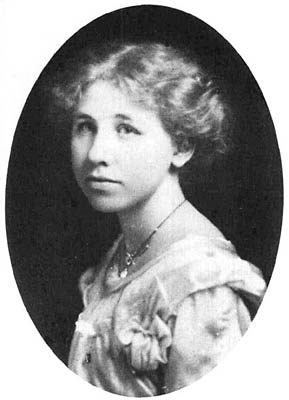
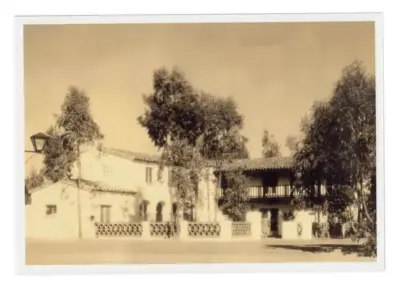
Lilian Rice: The Architect Who Gave Rancho Santa Fe Its Soul
Lilian Jeannette Rice was born in 1888 in National City, California, just south of San Diego. She was, by any measure, a woman ahead of her time. She earned her degree in architecture from the University of California, Berkeley — one of the first women ever to do so — and became only the tenth woman in the state of California to hold an architectural license.
Around 1920, she joined the firm of Requa and Jackson. Within two years, she was handed what her biographer Diane Y. Welch has described as “the job of a lifetime.” Richard Requa, occupied with other projects, passed the full responsibility for Rancho Santa Fe to Rice. She would serve as its resident supervising architect from 1922 until her death in 1938.
Rice’s design philosophy was shaped by her UC Berkeley training under master architect John Galen Howard, her affinity for the natural landscape of Southern California, and a transformative trip to Spain that became the defining influence on her architectural vocabulary. What she brought back — from Spanish Colonial, Pueblo, and Mediterranean architecture — became the visual language of Rancho Santa Fe.
Her buildings are marked by plastered walls with rounded corners, varied red-tiled rooflines, deep-set windows with decorative wrought iron and carved wood, and generous patios and courtyards designed to blur the boundary between inside and out. The forms are horizontal, restrained, and deeply in harmony with the landscape. As her biographer Diane Welch has written: “She wanted her buildings to meld, to be in harmony with the landscape. Why mess with nature by creating something to dominate it?”
The main boulevard she designed — Paseo Delicias — remains the spine of the Village today. La Morada, the guest house she created for the civic center, became what is now the Inn at Rancho Santa Fe. The row houses, the school, the water district offices, and dozens of private residences throughout the Covenant all bear her signature. In a career of just sixteen years, Rice designed approximately 100 buildings across San Diego — 60 of them within Rancho Santa Fe — many of which are now listed on the National Register of Historic Places.
Rice’s connection to the land’s deeper history is also notable. Among her projects was the rehabilitation of the original Osuna Adobe, the 1830s-era structure built by the Osuna family and the oldest remaining evidence of the ranch’s pre-railroad past. Her stewardship of that structure was entirely consistent with her broader approach: honor what came before, and build to belong.
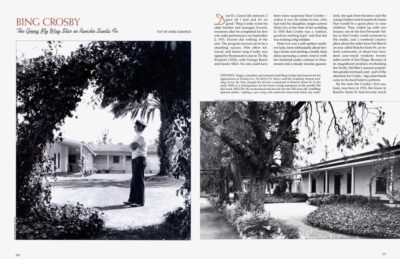
Among her most celebrated private commissions: the remodeling of the Juan María Osuna hacienda in 1934 for its then-owner, entertainer Bing Crosby.
A bronze statue of Lilian Rice now stands in North Village Park, commissioned by the Rancho Santa Fe Historical Society. It honors not only her buildings, but the philosophy behind them — her belief, stated in her own words, that the goal was “a community that would contain the simplicity and charm of a Spanish village.”
The Protective Covenant: Preserving the Vision
As lots were sold throughout the 1920s, the SFLIC moved deliberately to ensure that Rice’s architectural vision would outlast her involvement. In 1928, the newly formed Rancho Santa Fe Association formally adopted the Protective Covenant — a set of deed restrictions and architectural guidelines that to this day governs how land is used and how buildings are designed within the community.
Every renovation, addition, or new construction within the Covenant is reviewed by the Art Jury, a design board tasked with ensuring that what gets built here continues to honor the original character and spirit of the Ranch. Rooflines, materials, color palettes, landscape — all considered through the lens of a vision now nearly a century old.
In 1989, the State of California recognized the Covenant of Rancho Santa Fe as California Historical Landmark #982.
Golf, Bing Crosby, and the Community’s Golden Era
As the residential community took shape, the SFLIC donated nearly 220 acres for the creation of a golf course. Renowned course designer Max Behr was commissioned to design what would become the Rancho Santa Fe Golf Club, which officially opened in June 1929. Lots were soon marketed as golf course estates alongside the original gentleman farmer concept.
The club’s most storied chapter arrived in 1937, when Bing Crosby — by then a Rancho Santa Fe resident — inaugurated what he called “The Clambake” at the end of the annual horse racing season at the nearby Del Mar Thoroughbred Club. The informal tournament matched Hollywood celebrities against touring professionals and drew national attention to the community. The event eventually relocated to Pebble Beach, where it continues today as the AT&T Pebble Beach Pro-Am. A beloved local version of the tradition lives on at the Rancho Santa Fe Golf Club to this day.
Rancho Santa Fe Today
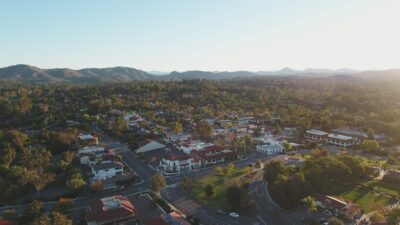
The community that emerged from a failed railroad experiment and a young architect’s vision has grown into one of the most consistently desirable addresses in the United States. With one of the highest household incomes of any zip code in California, a fiercely protected architectural identity, and a lifestyle defined by privacy, equestrian culture, golf, and proximity to the coast, Rancho Santa Fe draws buyers who are looking for something that cannot be manufactured: authenticity rooted in history.
The curving roads still follow the natural topography Sinnard laid out a century ago. The eucalyptus groves still line the lanes. The Spanish Colonial Revival buildings Rice designed still stand as the architectural soul of the Village. And the Covenant — adopted by a small group of landowners in 1928 — continues to protect all of it, generation after generation.
For those who live here, that continuity is not incidental. It is the point.
Explore Rancho Santa Fe homes currently available through the Jason Barry Team, or read our complete guide to living in Rancho Santa Fe for a deeper look at today’s communities, schools, and lifestyle.
Frequently Asked Questions
What is the history of Rancho Santa Fe? Rancho Santa Fe’s history begins with the Kumeyaay people, who inhabited the land for thousands of years. In the 1830s–1840s, it became the Mexican land grant Rancho San Dieguito, granted to Juan María Osuna. In 1906, the Atchison, Topeka & Santa Fe Railroad purchased the land and planted 3.5 million eucalyptus trees for railroad ties — an experiment that failed. The railroad then pivoted to create a master-planned residential community, renamed Rancho Santa Fe in 1921 and established under the Protective Covenant in 1928.
Who designed Rancho Santa Fe? The community’s architectural identity was shaped by Lilian Rice, who served as resident supervising architect for the Santa Fe Land Improvement Company from 1922 until her death in 1938. She designed approximately 100 buildings across San Diego during her career, 60 of them within Rancho Santa Fe, many of which are on the National Register of Historic Places. Learn more about her legacy at the Rancho Santa Fe Historical Society.
What is the Rancho Santa Fe Covenant? The Protective Covenant is a set of deed restrictions and architectural standards adopted in 1928 by the Rancho Santa Fe Association. It governs land use, building design, and development to preserve the character and aesthetic of the community. All new construction and renovations are reviewed by the Art Jury. The Covenant was designated a California Historical Landmark in 1989.
What architectural style is Rancho Santa Fe? Rancho Santa Fe is defined by Spanish Colonial Revival architecture, shaped by Lilian Rice’s synthesis of Spanish, Pueblo, and Mediterranean influences. Key features include plastered walls with rounded corners, red-tiled rooflines, deep-set windows with wrought iron details, and indoor-outdoor living spaces that connect homes to their natural surroundings.
Why are there so many eucalyptus trees in Rancho Santa Fe? The eucalyptus groves are remnants of the Santa Fe Railroad’s failed attempt, beginning in 1906, to grow timber for railroad ties. The wood proved unsuitable, but the trees remained and became one of Rancho Santa Fe’s most beloved and distinctive landscape features.
What is the Osuna Adobe in Rancho Santa Fe? The Osuna Adobe is the original adobe homestead built by the Osuna family in the 1830s — one of the oldest surviving structures in the region and the final remnant of the Osuna legacy in public ownership. It is now cared for by the Rancho Santa Fe Historical Society. Architect Lilian Rice later rehabilitated the structure as part of her work at Rancho Santa Fe, connecting the community’s earliest history to its 20th-century architectural identity.
Who are some famous residents of Rancho Santa Fe? Rancho Santa Fe has attracted notable residents throughout its history. Bing Crosby lived there in the 1930s and hosted his famous “Clambake” golf tournament at the Rancho Santa Fe Golf Club. The community has long been home to business leaders, entertainers, athletes, and prominent figures who value its privacy, beauty, and one-of-a-kind character.
The Jason Barry Team at Barry Estates has represented buyers and sellers in Rancho Santa Fe for more than 30 years, with over $6.5 billion in career sales across San Diego’s most sought-after communities. For a private conversation about buying or selling in Rancho Santa Fe, contact us today.